How to Read Fastq Files With Python
Overview
When you're working with Python, yous don't need to import a library in order to read and write to a file. It's handled natively in the language, albeit in a unique mode. Below, we outline the simple steps to read and write to a file in Python.
The first affair you'll need to do is utilize the congenital-in python open file function to go a file object .
The open up part opens a file. Information technology's uncomplicated. This is the first step in reading and writing files in python.

When you use the open role, it returns something called a file object . File objects contain methods and attributes that tin be used to collect data near the file you opened. They can besides exist used to manipulate said file.
For example, the way attribute of a file object tells you which mode a file was opened in. And the name attribute tells yous the proper name of the file.
You must understand that a file and file object are two wholly divide – yet related – things.
File Types
What you may know equally a file is slightly different in Python.
In Windows, for example, a file tin exist any item manipulated, edited or created by the user/Os. That means files can be images, text documents, executables, and excel file and much more. Most files are organized by keeping them in individual folders.
A file In Python is categorized every bit either text or binary, and the difference betwixt the 2 file types is important.
Text files are structured every bit a sequence of lines, where each line includes a sequence of characters. This is what y'all know as code or syntax.
Each line is terminated with a special character, called the EOL or Finish of Line character. There are several types, but the well-nigh common is the comma {,} or newline grapheme. It ends the current line and tells the interpreter a new i has begun.
A backslash character tin can also be used, and it tells the interpreter that the next character – following the slash – should be treated as a new line. This character is useful when you don't want to commencement a new line in the text itself just in the code.
A binary file is whatsoever type of file that is not a text file. Because of their nature, binary files can only be processed by an application that know or sympathise the file's structure. In other words, they must be applications that can read and interpret binary.
Reading Files in Python
In Python, files are read using the open() method. This is i of Python's built-in methods, made for opening files.
The open() function takes two arguments: a filename and a file opening mode. The filename points to the path of the file on your computer, while the file opening style is used to tell the open up() role how we plan to interact with the file.
By default, the file opening mode is set to read-simply, meaning we'll only accept permission to open and examine the contents of the file.
On my computer is a binder called PythonForBeginners. In that folder are three files. One is a text file named emily_dickinson.txt, and the other two are python files: read.py and write.py.
The text file contains the following poem, written by poet Emily Dickinson. Maybe nosotros are working on a poetry plan and have our poems stored equally files on the computer.
Success is counted sweetest
Past those who ne'er succeed.
To comprehend a nectar
Requires sorest need.
Not one of all the Imperial Host
Who took the Flag today
Can tell the definition
Then clear of Victory
As he defeated, dying
On whose forbidden ear
The distant strains of triumph
Burst agonized and clear.
Before we can do anything with the contents of the poem file, nosotros'll need to tell Python to open it. The file read.py, contains all the python code necessary to read the poem.
Any text editor can be used to write the code. I'm using the Atom code editor, which is my editor of pick for working in python.
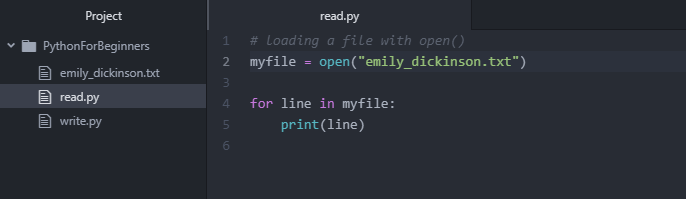
# read.py # loading a file with open up() myfile = open("emily_dickinson.txt") # reading each line of the file and printing to the console for line in myfile: impress(line) I've used Python comments to explicate each pace in the code. Follow this link to learn more about what a Python comment is.
The instance above illustrates how using a simple loop in Python can read the contents of a file.
When it comes to reading files, Python takes care of the heaving lifting behind the scenes. Run the script by navigating to the file using the Command Prompt — or Final — and typing 'python' followed past the name of the file.
Windows Users: Before you can utilize the python keyword in your Control Prompt, yous'll need to fix the environment variables. This should take happened automatically when you installed Python, but in case information technology didn't, you may demand to practise it manually.
>python read.py 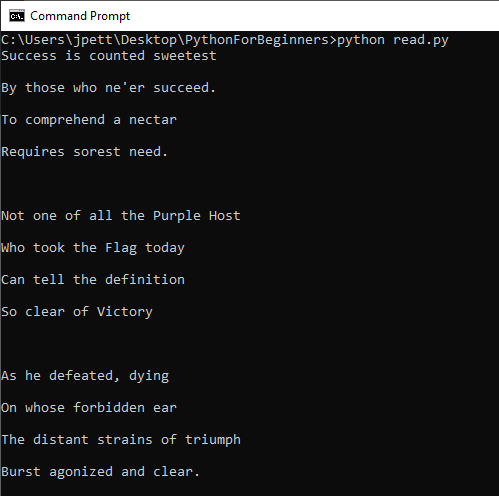
Data provided by the open() method is normally stored in a new variable. In this example, the contents of the verse form are stored in the variable "myfile."
Once the file is created, we can use a for loop to read every line in the file and impress its contents to the command line.
This is a very simple instance of how to open up a file in Python, but pupil's should be aware that the open() method is quite powerful. For some projects it will be the just thing needed to read and write files with Python.
Writing Files in Python
Earlier we can write to a file in Python, it must first be opened in a different file opening fashion. Nosotros can practice this by supplying the open() method with a special statement.
In Python, write to file using the open() method. Yous'll demand to laissez passer both a filename and a special character that tells Python we intend to write to the file.
Add the post-obit lawmaking to write.py. We'll tell Python to look for a file named "sample.txt" and overwrite its contents with a new message.
# open the file in write mode myfile = open("sample.txt",'w') myfile.write("Hello from Python!") Passing 'w' to the open() method tells Python to open up the file in write mode. In this style, whatsoever data already in the file is lost when the new information is written.
If the file doesn't exist, Python will create a new file. In this case, a new file named "sample.txt" will be created when the program runs.
Run the programme using the Command Prompt:
>python write.py Python tin can also write multiple lines to a file. The easiest fashion to do this is with the writelines() method.
# open the file in write mode myfile = open("sample.txt",'w') myfile.writelines("Hello World!","We're learning Python!") # shut the file myfile.close() Nosotros tin also write multiple lines to a file using special characters:
# open the file in write style myfile = open("poem.txt", 'west') line1 = "Roses are cherry-red.\due north" line2 = "Violets are blue.\north" line3 = "Python is dandy.\n" line4 = "And so are y'all.\n" myfile.write(line1 + line2 + line3 + line4) Using cord concatenation makes it possible for Python to save text information in a variety of ways.
Nonetheless, if we wanted to avoid overwriting the data in a file, and instead append it or alter it, we'd have to open up the file using another file opening style.
File Opening Modes
Past default, Python will open the file in read-merely mode. If nosotros desire to do anything other than just read a file, we'll need to manually tell Python what nosotros intend to exercise with it.
- 'r' – Read Manner: This is the default style for open up() . The file is opened and a arrow is positioned at the beginning of the file's content.
- 'w' – Write Way: Using this fashion will overwrite whatsoever existing content in a file. If the given file does not be, a new one will be created.
- 'r+' – Read/Write Way: Use this mode if y'all need to simultaneously read and write to a file.
- 'a' – Append Mode: With this mode the user can suspend the data without overwriting any already existing information in the file.
- 'a+' – Append and Read Mode: In this style you lot can read and append the data without overwriting the original file.
- 'ten' – Exclusive Creating Way: This mode is for the sole purpose of creating new files. Use this mode if you know the file to be written doesn't exist beforehand.
Note: These examples assume the user is working with text file types. If the intention is to read or write to a binary file type, an additional statement must be passed to the open up() method: the 'b' character.
# binary files need a special argument: 'b' binary_file = open("song_data.mp3",'rb') song_data = binary_file.read() # close the file binary_file.close() Endmost Files with Python
After opening a file in Python, it'south important to close it after you're washed with it. Closing a file ensures that the programme tin can no longer admission its contents.
Close a file with the close() method.
# open up a file myfile = open up("poem.txt") # an assortment to store the contents of the file lines = [] For line in myfile: lines.append(line) # shut the file myfile.close() For line in liens: impress(line) Opening Other File Types
The open up() method can read and write many different file types. Nosotros've seen how to open binary files and text files. Python can also open images, allowing you to view and edit their pixel data.
Before Python can open an image file, the Pillow library (Python Imaging Library) must be installed. Information technology's easiest to install this module using pip.
pip install Pillow With Pillow installed, Python can open image files and read their contents.
From PIL import Image # tell Pillow to open up the paradigm file img = Image.open("your_image_file.jpg") img.show() img.shut() The Pillow library includes powerful tools for editing images. This has made it i of the most popular Python libraries.
With Statement
You tin too work with file objects using the with statement. Information technology is designed to provide much cleaner syntax and exceptions treatment when you lot are working with code. That explains why it's skilful practice to utilize the with statement where applicable.
One bonus of using this method is that whatsoever files opened will exist closed automatically after you are done. This leaves less to worry about during cleanup.
To use the with statement to open up a file:
with open("filename") equally file: At present that you sympathise how to phone call this statement, let'due south take a look at a few examples.
with open("poem.txt") as file: data = file.read() do something with data You can also call upon other methods while using this statement. For instance, you can do something like loop over a file object:
with open up("poem.txt") as f: for line in f: print line, Yous'll also discover that in the above example we didn't use the " file.close() " method because the with statement will automatically call that for us upon execution. Information technology really makes things a lot easier, doesn't it?
Splitting Lines in a Text File
As a terminal case, permit's explore a unique function that allows y'all to split the lines taken from a text file. What this is designed to practise, is split the string contained in variable data whenever the interpreter encounters a infinite grapheme.
Simply merely considering nosotros are going to use it to split lines later a infinite character, doesn't hateful that'due south the simply style. You tin can really split your text using any character yous wish – such every bit a colon, for instance.
The code to practice this (also using a with statement) is:
with open( " howdy.text ", "r") as f: data = f.readlines () for line in data: words = line.split up () impress words If you wanted to use a colon instead of a infinite to split your text, you lot would but alter line.split() to line.split up(":").
The output for this will be:
["hello", "earth", "how", "are", "you", "today?"] ["today", "is", "Sat"] The reason the words are presented in this manner is because they are stored – and returned – as an assortment. Be sure to recollect this when working with the split function.
Decision
Reading and writing files in Python involves an understanding of the open() method. Past taking reward of this method'southward versatility, information technology's possible to read, write, and create files in Python.
Files Python can either be text files or binary files. Information technology'due south also possible to open and edit image data using the Pillow module.
In one case a file'south data is loaded in Python, at that place's virtually no end to what tin be done with information technology. Programmers oftentimes work with a large number of files, using programs to generate them automatically.
As with any lesson, there is only then much that tin can be covered in the space provided. Hopefully you've learned enough to get started reading and writing files in Python.
More Reading
Official Python Documentation – Reading and Writing Files
Python File Treatment Cheat Sheet
Recommended Python Grooming
Course: Python 3 For Beginners
Over 15 hours of video content with guided instruction for beginners. Learn how to create real earth applications and master the basics.
Source: https://www.pythonforbeginners.com/files/reading-and-writing-files-in-python

Post a Comment for "How to Read Fastq Files With Python"